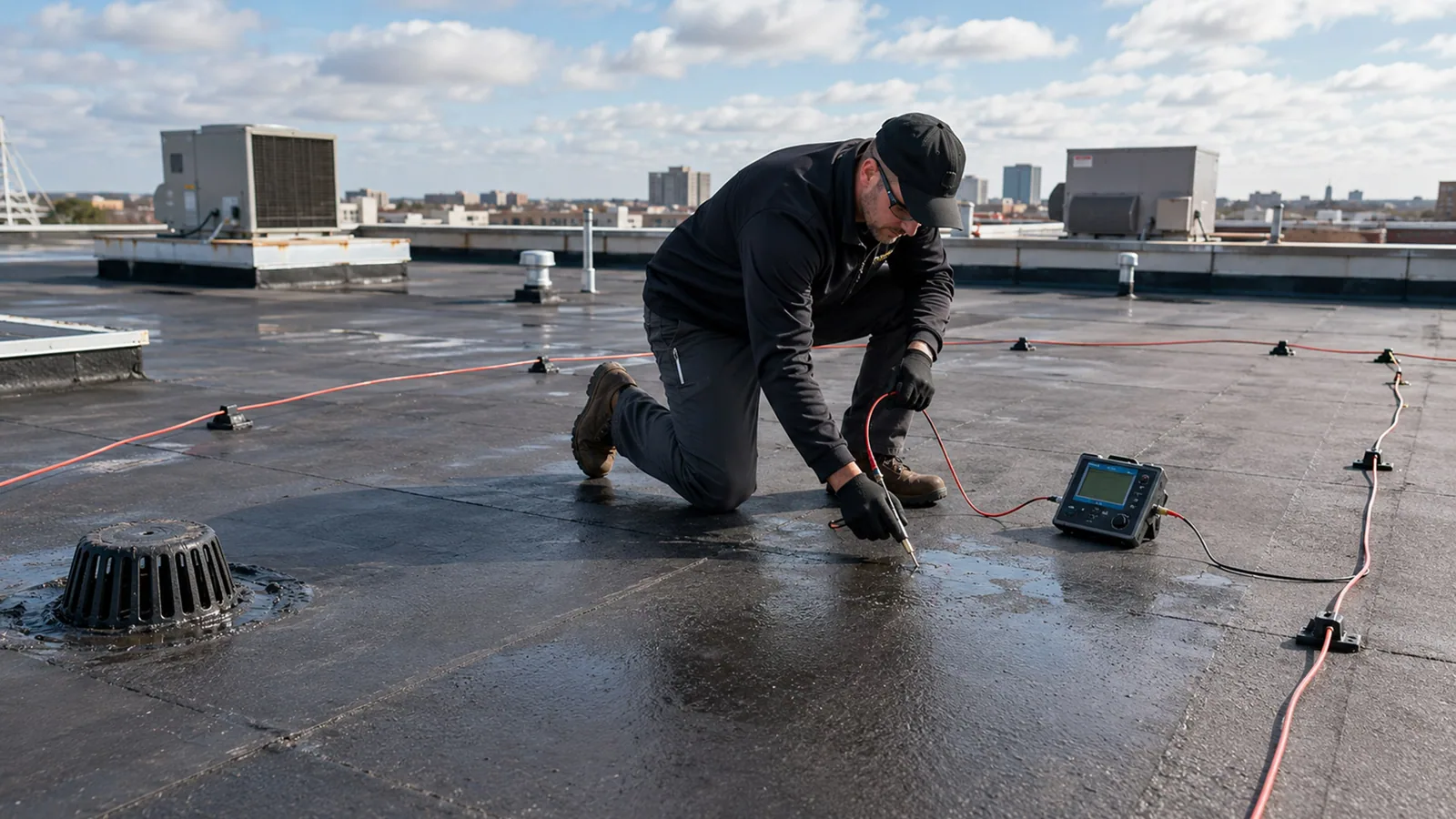

A curb above a busy entrance can complicate service at a Mustang retail or business property. We inspect the curb face, membrane return and nearby drains before setting a repair boundary. Mustang sits where State Highways 4 and 152 meet, south of Interstate 40. Restaurants, a national publishing company and national retailers form part of Mustang’s commercial mix. The building’s actual assembly and operating needs set the inspection record. Each roof receives its own photos and scope. Our commercial roof inspection documents the assembly, access route and operating limits before a proposal is written.
A storefront may receive deliveries while customers use the front drive. The crew needs a material path that avoids both movements. We confirm the service entrance, truck turn, loading interval and ground area for debris with the property contact. Where several tenants share a lot, a temporary barrier should leave the main approach legible. The roof access point may be behind the building, but the delivery route should not force equipment across customer parking. A marked plan helps the manager coordinate the day's work without closing more space than the repair requires.
Commercial development includes pad-site opportunities near busy intersections. We confirm the current tenant, roof assembly and construction at the property before pricing work. When roof work happens beside an active retail frontage, we protect the entrance and set a defined drop zone. The repair scope identifies where material is removed and where pedestrians must remain clear. Nearby work in Edmond or Oklahoma City can share travel planning, while each address retains its own inspection and approval. A separate Harrah service visit may fit another trip, but not another property's roof record.
Restaurant exhaust and packaged equipment can create multiple roof penetrations, but the equipment at any Mustang site must be confirmed in person. We inspect each curb for a continuous membrane return, secure clamping and sound backing. We note residue, staining, movement or loosened flashing where observed rather than assume which condition caused it. A loose counterflashing or open corner should be repaired at its actual boundary. The scope names each penetration and the material selected for its assembly. It does not combine unrelated curbs because they appear close together on a plan.
Where two roof planes meet, water follows the lap and the edge condition. We check whether the upper sheet sheds over the lower one, and whether fasteners hold the assembly to its support. At a metal transition, a replacement fastener must fit the panel profile and substrate. At a membrane return, the sheet needs compatible preparation and a clean weld or bonded connection. The termination enters the scope only when that is the observed issue. A broader commercial roof repair scope can separate curb, seam and drain work by location.
For a curb repair, we note the unit, curb face and adjacent sheet before removal. We photograph each corner and check whether the old flashing remains bonded. If the equipment needs to keep running, the contact confirms that condition before the crew works nearby. The finished record identifies the repaired connection and any remaining observation for the next visit.
Spring in Oklahoma can bring severe storms with hail, damaging gusts or tornadoes; a second period occurs in autumn. Summer heat also affects material handling. The inspection records any observed storm-related condition at the Mustang property. We check the field, perimeter and curbs at the address. Before opening a section, the foreman and property contact set the day's closure line and decide how exposed work will be secured if conditions change. Temporary cover is logged apart from permanent repair.
At an occupied storefront, the closeout should identify any interior protection and the route used to move material. If wind has displaced metal or lifted an edge, we photograph the detail from a safe position and compare it with the roof plan. A storm-damage review distinguishes what was observed from the weather history supplied by the owner. It also notes whether temporary protection remains in place. Each report stays tied to the inspected property and its approved work area. A local manager receives the photos and the approved repair limit before permanent work starts.
Packaging, leaves and cut material can collect at a drain while crews work near an entrance or parapet. We identify the primary outlet, overflow and downspout before staging. Any temporary cover comes off before the crew leaves. If ponding remains, we measure the low area and note its distance from the drain. A blocked bowl may need cleaning; a separated flashing or loose clamp needs a compatible repair. If flow still stalls after debris is cleared, the next step may require elevation measurements rather than a quick patch.
Roof drainage also affects the maintenance sequence. We record which outlets were cleared and which connections need follow-up. An owner can use preventive roof maintenance to track that work and schedule a later review. If the roof has several assemblies, each receives a separate condition note and material recommendation. An overlay evaluation should wait until moisture, attachment and load conditions are checked. We compare retention, repair and replacement only after those findings are documented. The property contact can then decide which scope fits the operating calendar and the budget approval path.
At the end of the visit, we review the repaired connection and the areas left unchanged. Photos should show the approach, curb or seam and the finished boundary. The work record names the material and any condition that still needs observation. A roof condition report gives the manager a usable reference for the next service call. For a multi-tenant retail building, the report should say which bay or entrance relates to each image without implying that neighboring suites were inspected.
A replacement decision should start with measured condition and assembly compatibility. We identify repairable details, wet or unstable areas and any open question requiring another test. Replacement planning can compare phased work, access and protection around store hours. If an existing system may remain in service, the evaluation must confirm attachment and moisture before an overlay is considered. The next scope should state what is included, what is excluded and what will trigger a pause. Arrange a review of the Mustang building's roof access, penetrations and drainage. The inspection can settle which work belongs in the first proposal.
Arrange a close inspection of the Mustang roof, customer routes and equipment connections. The visit helps define a safe work sequence and repair boundary.
The owner sets that operating limit after the approach and material route are reviewed. We can sequence work around the selected entrance and mark any temporary restriction.
Equipment use can affect nearby details, but the installed assembly and observed condition decide the repair. We check the curb, backing and membrane return directly.
No. A development plan describes opportunities and local business context, not a specific building assembly. We inspect the roof at the address being considered.
A location-specific record of visible conditions, photographs, temporary protection and the boundary proposed for permanent work.
After the roof assembly, moisture, attachment and load conditions are checked. Those findings determine whether retention is a sound option.